Starbucks Water Intrusion Investigation in San Antonio, TX
What the Client Was Experiencing
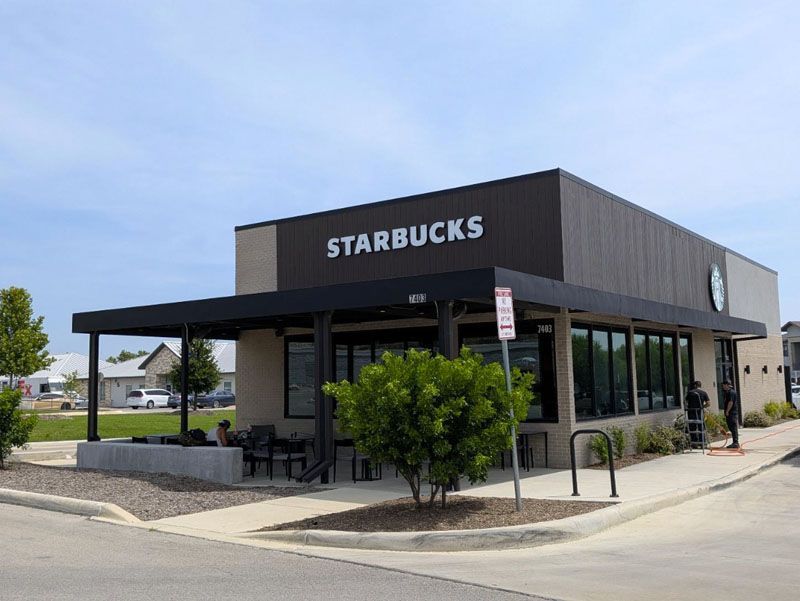
A San Antonio Starbucks location had reported water intrusion concerns at a storefront window and at a patio entryway door. From a building envelope standpoint, that kind of complaint can point to more than one failure path. Leaks around a storefront window or door threshold can be tied to the wall system, sealant joints, flashing details, or drainage conditions that are not obvious from the inside.
The priority on this project was to determine whether active water intrusion could be confirmed at each reported area, without destructive disassembly of building components, and give the client a reliable basis for next-step repairs.
Our Water Intrusion Testing Approach
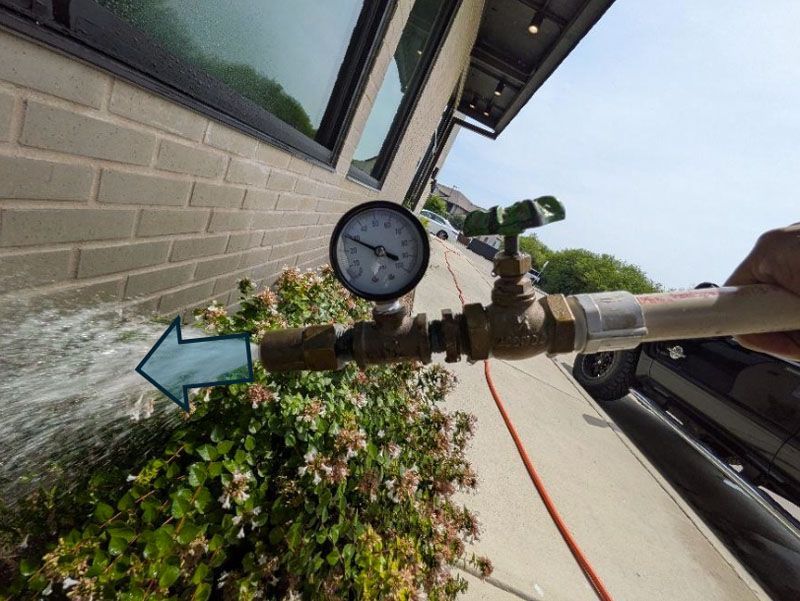
Building Envelope Solutions performed a diagnostic field water penetration testing site visit at the location. Our methodology combined visual observations with AAMA 501.2 diagnostic field water penetration testing, using a calibrated spray nozzle at approximately 30 psi to reproduce wind-driven rain conditions.
Testing focused on three areas the client had flagged: the storefront window, a nearby cladding crack, and two exterior doors. The window was tested in eight sequential locations, including the foundation-to-wall transition, the cladding beneath the windowsill, the windowsill itself, the upper and lower window, the window header, the sealant and cladding above the header, and the lower portion of the awning-to-wall transition. The main entry door and the patio entry door were each flood tested, and the cladding crack was tested separately to rule it in or out as a contributing factor.
This kind of structured, sequence-based testing matters because storefront and retail leak complaints are frequently misdiagnosed. A repair contractor may focus on the first visible symptom, while the actual water entry path is higher on the wall, at a transition, or at a door threshold that looks fine at a glance.
What Building Envelope Solutions Found
Testing at the window did not show water intrusion until the area above the window header and below the awning was tested. At that point, water intrusion occurred within five minutes, and the test was stopped. A closer look showed small sealant cohesion failures and flashing that was not performing as designed, allowing water to enter through the wall system at that transition.
By contrast, the nearby cladding crack was tested for six minutes with no water intrusion observed, ruling it out as a contributing source.
Both doors told a similar story. The main entry door showed water intrusion within one minute of testing. The patio entry door showed water intrusion within one minute of water reaching the door. In both cases, a negative slope at the threshold was allowing water to pool against the door rather than drain away from it.
How BES Helped the Property Owner
The value of this project was in separating where water was entering from where it was not. Testing confirmed that the window header and awning transition, along with the negative slope at both door thresholds, were the actual sources of water intrusion, while the nearby cladding crack was cleared.
Based on the findings, Building Envelope Solutions recommended a Scope of Work to expose the failed building elements at the window transition so the underlying conditions can be documented and corrected, along with a separate Scope of Work for drainage correction at both door thresholds to properly direct water away from the building.
Our report for the client included 7 photos with detail showing where the water issue was.
Why This Matters for Commercial and Retail Properties
Storefront water intrusion in San Antonio is rarely limited to what is visible from inside. Awnings, window headers, sealant joints, and door thresholds all interact with wind-driven rain, material movement, and long-term wear, and a leak at one of these details can look identical to a leak somewhere else entirely.
This project is a good example of why retail and
commercial leak investigation should rely on controlled testing rather than assumption. When a consultant can isolate where water is and is not entering, the property owner is in a far better position to plan repairs, budget accurately, and avoid paying for the wrong fix.
Need Water Intrusion Testing in San Antonio?
If your commercial or retail property is dealing with a leak around a storefront window, entry door, or awning, Building Envelope Solutions can help confirm where water is entering and guide the next step.
Contact our team to schedule
AAMA 501.2 water intrusion testing or a broader
building envelope consulting assessment in the San Antonio area.
What is AAMA 501.2 testing?
AAMA 501.2 is a standardized field test that uses a calibrated water spray to check whether a window, door, or wall assembly is allowing water intrusion under controlled conditions. It helps confirm exactly where water is entering instead of relying on visible symptoms alone.
Why did the window fail testing while a nearby wall crack did not?
Different parts of a building envelope perform differently depending on the sealant, flashing, and installation details at each location. Testing each area separately showed that the window header and awning transition were allowing water in, while the nearby cladding crack was not a contributing factor.
What does a negative slope at a door threshold mean?
A negative slope means the ground or transition at a door threshold directs water toward the door instead of away from it. This allows water to pool against the threshold and can lead to water intrusion, even when the door itself is in good condition.
What happens after a water intrusion investigation like this one?
Once the source of intrusion is confirmed, a Scope of Work can be developed to guide repairs at the affected areas. This often includes documenting the underlying conditions once the area is opened up, followed by a defined plan for correcting the identified building envelope issues.